Showing posts with label Spain. Show all posts
Showing posts with label Spain. Show all posts
Friday, 19 June 2015
Spanish Traditional Costumes
Here you can see two typical old costumes from Valentian country (Spain), for men and women. People working on the fields used to wear a simple version of these clothes. Now they have been modified to be showed in folklore performances.

Monday, 13 April 2015
Multilingual Dictionary
Hi everyone ! Here is the link to a short
dictionary prepared by some of our students in 6th grade of our school. Enjoy it !
https://dl.dropboxusercontent.com/u/219107001/Dictionary%20Comenius.pdf

https://dl.dropboxusercontent.com/u/219107001/Dictionary%20Comenius.pdf
Wednesday, 1 April 2015
Three Spanish folk songs
Here you can listen to three traditional songs from different regions of Spain played by Rajoletes students.


Aurtxoa seaskan
Monday, 30 March 2015
Spanish dance
"L'Alegria" (The happiness) is a traditional Spanish dance from the East of Spain. People -boys and girls alternatively- dance around a mast crossing and twinning ribbons. Music is played by a typical flute "dolçaina" and a small drum "tabalet", which use to accompany our traditional celebrations.
Thursday, 8 January 2015
Spanish Christmas Festival

Here you can see pupils from 5th grade (10-11 years old) singing in the Christmas Festival recently celebrated at the Culture House of Sant Joan d'Alacant. They played at this occasion two traditional songs "Mareta, mareta" (in valentian language) and "Aurtxoa seaskan" (in basque language) that you can listen one in the following link

The lyrics say Phonetical transcription
Mareta, mareta [Mare'ta, mare'ta]
anit vaig somiar [anit' vatʃ somia']
la nina tenia [la ni'na teni'a]
bonicos els ulls, [boni'kos els uʎs]
la cara molt fina [la ka'ra mol fi'na]
i els cabells molt rulls [i els kabeʎs' mol ruʎs]
And they mean, more or less
Sweet mom, sweet mom
tonight I dreamed
a little girl she had
pretty eyes,
a thin face
and a curly hair
Wednesday, 3 December 2014
"Molletes" cake
This is a video made by a family of Rajoletes School. "Molletes" cake is a typical cake by Alicante's area, very appreciated and usually eaten in many different occasions: as a breakfast, as a appetizer or as a dessert. Try and enjoy it!
COCA DE MOLLETES from Tirant Lo Vert on Vimeo.
Thursday, 20 November 2014
Spanish dishes
Hi, people! Are you hungry? Ready to have a Spanish lunch?
Andalusian cold soup "Gazpacho" from Tirant Lo Vert on Vimeo.
Wednesday, 8 October 2014
9th October, national day of the Valencian country
9th October is the national day of our region. In this date of the year 1238 the king Jaume I the Conqueror entered to Valencia and create the Kingdom of Valencia which survived until the 18th century. 9th october we remember this date as the origin of a nation, with its own language, its own laws, its own identity. In the video you can see some activities related with these commemoration: costumes, ornaments, performances, plays... The sound is a tipycal melody for these occasion or similar, "La Moixeranga", played with a tipycal instrument, a local kind of flute "la dolçaina" and a small drum "el tabalet".
Tuesday, 1 July 2014
Hi everyone ! Here is the new post with the indicated Turkish words now corrected. This is a work done by the students of 5th grade at our school. The kids did some research and picked some similar words (or not that similar) in Hungarian, Turkish, English and Spanish. These are the kids' choices:
ENGLISH
|
TURKISH
|
HUNGARIAN
|
SPANISH
|
|
Greetings
|
Hello
|
Merhaba
|
Helló
|
Hola
|
Goodbye
|
Elveda
|
Viszlàt
|
Adiós
|
|
Food
|
Food
|
Yiyecek
|
Étel
|
Comida
|
Rice
|
Pirinç
|
Rizs
|
Arroz
|
|
Banana
|
Muz
|
Banán
|
Plátano / Banana
|
|
Orange
|
Portakal
|
Narancs
|
Naranja
|
|
Salad
|
Salata
|
Saláta
|
Ensalada
|
|
Marmalade
|
Marmelat
|
Lekvár
|
Mermelada
|
|
Macaroni
|
Makarna
|
Makaróni
|
Macarrones
|
|
Sandwich
|
Sandviç
|
Szendvic
|
Sandwich
|
|
Drinks
|
Coffee
|
Kahve
|
Kávé
|
Café
|
Beer
|
Bira
|
Sör
|
Cerveza
|
|
Animals
|
Giraffe
|
Zürafa
|
Girafa
|
Girafa
|
Hippo
|
Su aygiri
|
Viziló
|
Hipopótamo
|
|
Elephant
|
Fil
|
Elefánt
|
Elefante
|
|
Gorilla
|
Goril
|
Gorilla
|
Gorila
|
|
Penguin
|
Penguen
|
Pingvin
|
Pingüino
|
|
Sports
|
Surf
|
Sörf
|
Surf
|
Surfear
|
Football
|
Futbol
|
Futball
|
Fútbol
|
|
Transport
|
Car
|
Araba
|
Auto
|
Coche
|
Motorbike
|
Motosiklet
|
Motorkerékpár
|
Motocicleta
|
|
Bycicle
|
Bisiklet
|
Kerékpár
|
Bicicleta
|
|
Clothes
|
Pants
|
Pantolon
|
Nadrág
|
Pantalón
|
Boot
|
Bot
|
Csizma
|
Bota
|
|
Other
|
Dad
|
Baba
|
Apa
|
Dad
|
April
|
Nisan
|
Április
|
April
|
|
One
|
Bir
|
Egy
|
Uno
|
|
University
|
Üniversite
|
Egyetemi
|
Universidad
|
|
Alcohol
|
Alkol
|
Alkohol
|
Alcohol
|
|
Astronaut
|
Astronot
|
Astronaut
|
Astronauta
|
|
Hotel
|
Otel
|
Hotel
|
Hotel
|
|
Skeleton
|
Iskelet
|
Csontváz
|
Esqueleto
|
|
Planet
|
Planet
|
Bolygó
|
Planeta
|
Tuesday, 3 June 2014

Wednesday, 16 April 2014
Edible Childhood Ethnobotany
An interesting article (complete in Spanish or Catalan; in English, only an extract) written by a teacher collaborating with our school. He tells about ethnobotanical traditions performed by children.
After clicking the link, select "English" on the right corner.
Etnobotànica infantil mengívola
After clicking the link, select "English" on the right corner.
Etnobotànica infantil mengívola
Saturday, 5 April 2014
Spanish recipes I
These Spanish recipes have been written by pupils of 3rd grade (9 years old) of Rajoletes School. They have been originally written in Valentian language and after that, they have been translated in English. We have only selected some of the most popular recipes, as "paella", which probably you know. We hope we will have occasion to taste them at the moment of the meeting in Spain.
http://issuu.com/japujol/docs/spanish_recipes/1
http://issuu.com/japujol/docs/spanish_recipes/1
Wednesday, 8 January 2014
Sunday, 22 December 2013
Christmas activities
Christmas Trees


Christmas Tree is not a Spanish long tradition. It was introduced in 60s, but since then it has been gradually replacing the Bethlehem in the Spanish homes. The Bethlehem, that one is an old tradition for centuries, small figures depicting different scenes from the life of Jesus.
Christmas Street Market


Students and families of 6th grade set a place on the Saturday Street Market in Sant Joan. They sold handicrafts and sweets to earn money to pay their ending trip of the year, in June.
Rajoletes Choir
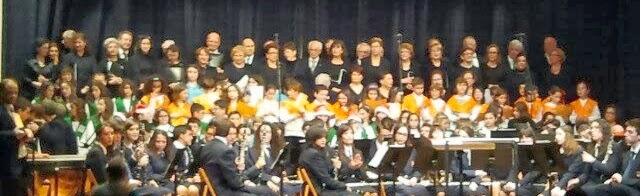
Students of 4th grade sang a carol themselves and another one accompanied by the Choir of Sant Joan d'Alacant and the Music Band of Agost.
Christmas Tree is not a Spanish long tradition. It was introduced in 60s, but since then it has been gradually replacing the Bethlehem in the Spanish homes. The Bethlehem, that one is an old tradition for centuries, small figures depicting different scenes from the life of Jesus.
Christmas Street Market
Students and families of 6th grade set a place on the Saturday Street Market in Sant Joan. They sold handicrafts and sweets to earn money to pay their ending trip of the year, in June.
Rajoletes Choir


Students of 4th grade sang a carol themselves and another one accompanied by the Choir of Sant Joan d'Alacant and the Music Band of Agost.


Thursday, 19 December 2013
MERRY CHRISTMAS COMENIUS PARTNERS !
HERE IS A REALLY HOMEMADE VIDEO BY THE STUDENTS OF 5TH GRADE OF OUR SCHOOL.
A CHRISTMAS RECIPE: TURRÓN.
ENJOY IT !

HERE IS A REALLY HOMEMADE VIDEO BY THE STUDENTS OF 5TH GRADE OF OUR SCHOOL.
A CHRISTMAS RECIPE: TURRÓN.
ENJOY IT !

Monday, 16 December 2013
Spanish Christmas traditions

Thursday, 12 December 2013
Book Christmas Tree

What do we have the most? Books, many books. And books are made with the same essence than trees. So, this year we have decided to raise our Christmas Tree with a lot of books: novels, atlas, dictionaries, essays, tales, poems...
Furthermore, stars have been made in our Art classroom with clay from Agost, an important area well-known by its pottery industry.
Finally, on the top of the tree there is a metaphor only accessible for people knowing it. The big book in brown is the official dictionary published by an important institution, with many ressources, and above, in black and white, there is a dictionary made by a woman along many years, working alone. Specialised people valuate this dictionary as better than the official one.
Merry Christmas and a Happy New Year 2014
Rajoletes School
(Spain)
Monday, 9 December 2013
Speech on Eurofest

Recently we were asked to explain our Comenius project to other schools from the Alicante area. This was a scheme of our speech.
This is the third experience in a Comenius project. Why Comenius? Why we participate so frequently at this?
Europe
In our Educational Project of School (2007, revised in 2013) we listed ten focused ideas which guide our educational practice. One of them, the European dimension. But, for us, Europe is not only a geographical reference, it is also a way of life, a concept. Surely, that idea is not the same that we are nowadays about Europe, because the context and the people were different. So, we must specify what we mean when we say « Europe ». For us, the idea of Europe is defined basically for two aspects: the Welfare State and Citizenship.
Probably, to define a word is better comparing it with border concepts. Then, a citizen is not a serf, and not also a person who acts only for its own interests. A citizen participates actively in the government of the res publica, from a critical point of view, and he is strongly engaged with improving the government of the full society.
The Welfare State is a social system built along the second half of the 20th century, after the II World War. It is a state of consolidated rights: political rights as democracy and equality in front of the justice; economical rights gained through negotiations and agreements; and social rights as an universal and free health system and an universal educational system. Nowadays these rights are refused from different fronts.
Strong roots to grow up higher
Cultural traditions is also a guideline which inspires our work. We can define « Culture » in different ways, but we will try our own one. Culture is a collective adaptation to the natural and social environment, a system made of elements closely linked in a dynamic and harmonic ensemble. The previous generation lived following the natural cycles and rythms.
Day and night, seasons, agricultural process... conditioned the human productions, not only at work but also in believes and feelings. Languages, songs, legends, dances, sayings, tales, arts, handcrafts, habits, customs, costumes, gastronomy, festivities... material and unmaterial creations were developed in a harmonic way.
Nowadays, we have lost many of these references and we unknow the genuine sense of these usages, corrupting them. We believe that the school should keep, revise and study them, because understanding we can apply them to new contexts.
Ecological and global challenge
Not many years ago, the human acting area was geographycally limited to the near physical environment, but now the ecological niche achieved the full planet. Natural, social, economical or political processes are nowadays widely outspread. Globalization is the name used to describe these processes, but a new word « Glocalization » has been created to develop an action programme: thinking global, acting local. We must think and analyze the events -pollution, migration, crisis- in a global way, but we have to work in the close area, according the global context.
Healthy school
According the World Health Organization the concept of health is an state of physical, mental and emotional wellbeing. We work in this way to create a healthy atmosphere at school : good habits of nutrition, physical exercice, active life, but also social abilities, empathy, self-confidence are present in our daily educational work.
The healthy personality claims for a healthy society which cannot forgive their members in risk of exclusion. It is the reason because disabled people are fully included in our project and all activities are thought to be developed with them.

Basically, all these guidelines are involved in the Comenius project whose goals are integrated with the ordinary curriculum and other alternative programs. The main goals proposed are the following ones:
- Know our own and the partner’s culture: traditional food, songs and dances.
- Learning Geography and History: the map of Europe, road map, climate graphics. Historical common events. Biographies...
- Communicating through Arts: dessign, photo, video, painting, music…
- Improving English communication abilities.
- Learning ICT tools: eTwinning, blog, facebook, website…
- Including students with learning and social difficulties.
Our project involves our community collaborating with many oganisations: the local government, the local media, groups of arts, parents association, NGOs...
(After this introduction we talked about the specific activities developed in the project: logo, festivals, market, films, performances, recipes book, cooking sessions...).
Subscribe to:
Posts (Atom)